


Re Shot
Reshot
2018 2025
Vanessa Rusci’s artistic practice has always been guided by a deep attention to memory, the body, and the traces that time leaves on images.
In Reshot, this interest focuses directly on photography as a living, fragile, and mutable matter, capable of telling as much as of dissolving.
The project begins with printed analog photographs, true relics of a tangible past. It continues with printed digital photographs, signs of a transitional phase in which the image starts to lose its material weight. Today it extends to images born on social networks, fleeting photographs destined to vanish rapidly in digital flows. Through these three stages, Reshot retraces the very history of photography, from its physical objecthood to its progressive dematerialization.
The artistic gesture is both simple and radical: Rusci takes these images and re-photographs them with her smartphone, but first performs an additional, decisive action. Each time, she places a present-day object onto the photograph — a quotidian detail, a tangible sign of the here and now — and only then does she shoot again. This insertion creates a temporal short-circuit: the past fixed in the photograph meets the materiality of the present, and the image becomes a hybrid, a fragment of memory transformed.
Each re-shot is accompanied by titles and texts. When an original title exists, it is indicated; other times, a new one is created. Short written notes open two perspectives: at times they recount what the artist truly remembers from that moment, at others what she wished she had remembered, or what she would have wanted to happen. In this oscillation between memory and desire, between recollection and rewriting, photography becomes a narrative space and a field of possibilities.
A crucial aspect of the project is the immediate re-sharing of images on social networks. After being re-shot, each photograph re-enters the flow of rapid viewing and hyper-production that defines today’s visual culture. Immersed in the “Ganges” of ephemeral consumption, the images appear, are quickly consumed and forgotten, only to resurface again. This continuous cycle underlines how memory, today, is an endless process of loss and regeneration.
Reshot thus takes the form of a discontinuous diary, an archive that does not preserve but transforms. Each image carries with it a stratification of times and meanings, where memory is never stable but always rewritten. The work shows how recollection is, inevitably, a creative act.
The project draws on Jungian and archetypal reflections, particularly the studies of Marie-Louise von Franz, and intersects with teachings and encounters significant to Rusci’s path, such as those with Ottavio Rosati and Luciana Santioli. In this perspective, memory is not only personal but also symbolic and collective, a field of images belonging both to the individual and to the shared imaginary.
Aesthetically, Reshot does not seek formal perfection but the authenticity of the gesture. The smartphone, a daily tool, becomes an artistic medium: not to replicate, but to emphasize that contemporary memory is composed of continuous grafts, of presences overlapping the past.
The act of re-sharing on social networks restores to the images the destiny of appearing and disappearing, resurfacing and dissolving — just as our memories do.
Inserted into the broader artistic process of Vanessa Rusci, Reshot stands as a reflection on the fate of photography and memory: no longer the certainty of the past, but an unstable surface, always ready to transform. Each image is at once relic and reinvention, document and desire, recollection and narrative.
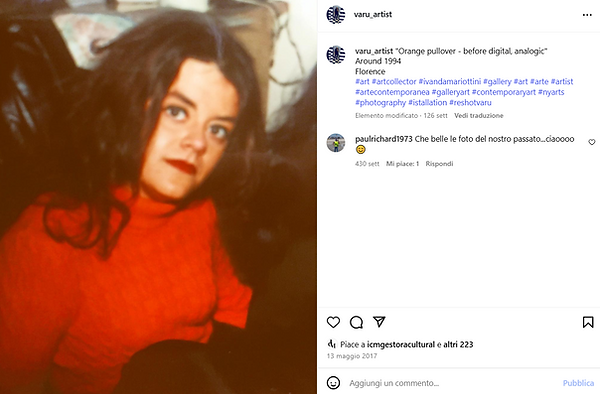


Reshot:
A diary of time leaps,
a study on memory,
on the relationship between photography and memory,
on the use of the image at the time of
Social Network.
I re-photograph an old photograph of mine
taken from social media or from my photo archives,
I recontextualize it and give it a new title.
The new photograph is taken with a Smartphone, uploaded to social networks: Facebook or Instagram, and sometimes I write a text to accompany it.
Our memory changes according to space, time, our vital state.
Become a work of art.

 |  |  |  |  |
|---|---|---|---|---|
 |  |  |  |  |
 |  |  |  |  |
 |  |  |  |  |
 |  |  |  |  |
 |